
Thunderstorms are among the most dangerous weather phenomena encountered in aviation. They can produce severe turbulence, lightning, hail, icing, wind shear, heavy rain, and even tornadoes. For pilots, understanding how thunderstorms form and how they affect aircraft operations is essential for flight safety.
What is a Thunderstorm?
A thunderstorm is a weather system characterized by the presence of lightning and thunder. It develops from a cumulonimbus cloud when the atmosphere becomes unstable and warm, moist air rises rapidly into colder regions of the atmosphere.
Thunderstorms can vary in intensity from small isolated cells to massive storm systems extending hundreds of kilometers.
How do Thunderstorms form?
Three main ingredients are necessary for thunderstorm development:
1. Moisture: Warm, humid air provides the water vapor needed to form clouds and
precipitation.
2. Instability: The atmosphere must allow warm air to continue rising once lifted.
3. Lifting Mechanism: A force such as a cold front, mountain slope, or surface heating lifts the warm air upward.
As the warm air rises, it cools and condenses into
clouds. If conditions are favorable, the cloud grows vertically into a towering
cumulonimbus cloud capable of producing thunderstorms.
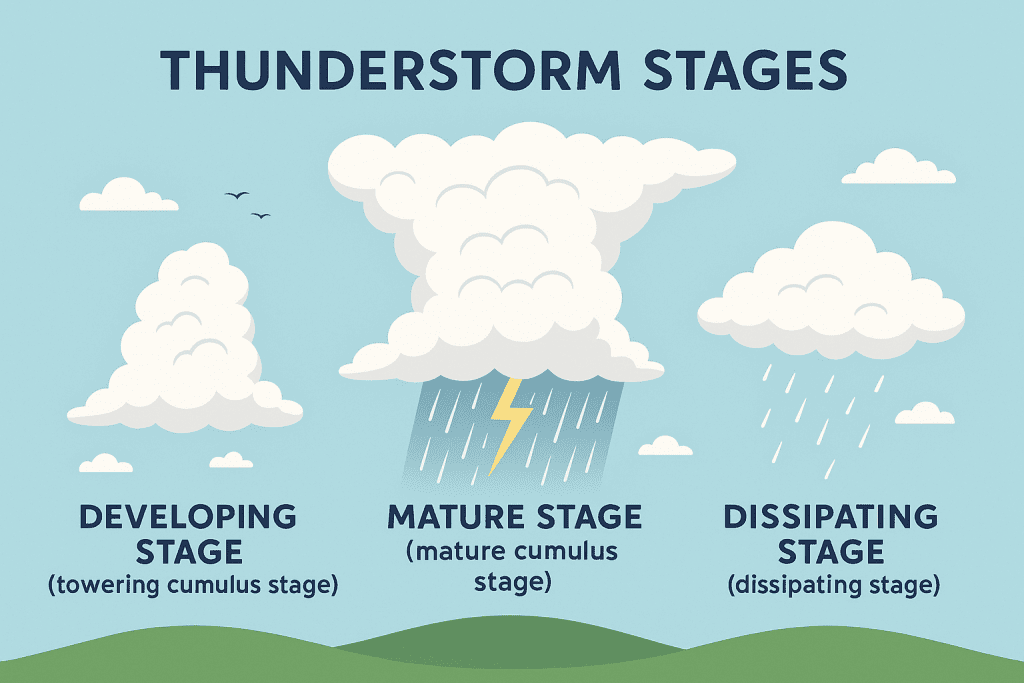
Stages of a Thunderstorm
- Cumulus Stage
This is the developing stage. Warm air rises continuously, forming towering cumulus clouds. No precipitation falls yet.
Characteristics:
- Strong updrafts
- Rapid cloud growth
- Increasing turbulence
- Mature Stage
This is the most dangerous stage for aviation.
Characteristics:
- Heavy rain
- Lightning and thunder
- Strong turbulence
- Hail
- Downdrafts
- Wind shear
Both updrafts and downdrafts exist simultaneously during this stage.
- Dissipating Stage
The downdrafts dominate and cut off the supply of warm rising air.
Characteristics:
- Weakening precipitation
- Reduced turbulence
- Decreasing cloud activity
What are the hazards associated to Thunderstorms?
Those hazards are:
- Severe Turbulence
- Windshear and Microbursts
- Lightning
- Hail
- Heavy Rain
- Icing
How do Pilots avoid Thunderstorms?
1- Weather Briefings
Before departure, pilots study:
- METARs
- TAFs
- SIGMETs
- Satellite images
2- Onboard Weather Radar
Modern aircraft use weather radar to detect storm intensity and
precipitation areas.
3- Safe Distance
Pilots generally avoid thunderstorms by at least:
- 20 nautical miles laterally
- Especially near the anvil area
4- Flight Planning
Routes may be changed to avoid convective activity.
Air traffic control often assists pilots with thunderstorm deviations.
Thunderstorms are powerful atmospheric phenomena capable of creating some of the most hazardous flying conditions. From turbulence and lightning to hail and wind shear, they present serious risks to aircraft operations. They should utmost be avoided.
Great content! Keep up the good work!